

Have you ever experienced a strange combination of neck tension, unsteadiness, visual fatigue, poor posture or discomfort when moving your head? Perhaps you have tried stretching, posture exercises, relaxation techniques or countless online suggestions without ever finding a simple routine that tells you what to do and when to do it.
That is the problem Neck Balance Reset is designed to address.
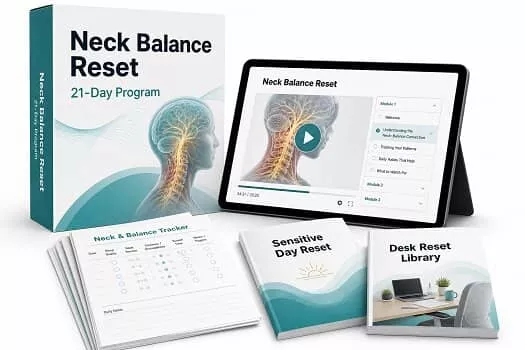
Neck Balance Reset is a 21-day confidence-building educational self-management program built around the connection between neck positioning, posture, visual input and movement. Instead of giving users another huge collection of exercises, the program focuses on understanding patterns, calming a reactive system, practicing gentle neck movement and rebuilding coordination.
What immediately makes this approach interesting is its emphasis on neck positioning and movement quality rather than simply trying to stretch harder.
The program introduces what it calls the Cervical Balance Reflex, a framework describing how your neck, eyes, posture and balance system work together while your brain interprets where your body is in space.
For anyone searching for a more structured approach to neck-related movement concerns, Neck Balance Reset offers a practical 21-day framework instead of another random list of tips.
Table of Contents
What Is Neck Balance Reset?
Neck Balance Reset is a 21-day educational program created for adults who feel that neck tension, posture strain, screen habits and head movement may be connected to their sense of unsteadiness or reduced movement confidence.
The program is organized around short lessons, gentle routines, tracking tools and safety-first guidance.
Rather than encouraging users to aggressively stretch the neck or push through uncomfortable symptoms, Neck Balance Reset emphasizes:
- Tracking patterns before reacting to them
- Using a 90-second reset when the system feels reactive
- Calming the neck, jaw, shoulders and breathing before mobility exercises
- Practicing small, comfortable neck movements
- Developing awareness of deep neck stabilizers
- Working on head-eye coordination
- Adjusting routines on more sensitive days
- Gradually rebuilding confidence in ordinary movement
This makes the product feel less like a traditional exercise program and more like a structured movement-management system.
The key idea is simple: more exercise is not necessarily better. Sometimes the bigger challenge is knowing which movement is appropriate, how much to do and when to reduce intensity.
The Cervical Balance Reflex Explained
One of the most important concepts presented in Neck Balance Reset is the Cervical Balance Reflex.
The program explains that your brain constantly combines information from multiple systems, including the eyes, inner ear, joints, muscles, neck and posture, to develop an understanding of where the body is positioned in space.
Your neck therefore contributes more than simple flexibility.
Position signals from the neck can help provide information about head and body positioning. According to the program’s framework, when those signals feel noisy, guarded, tense or mismatched with visual information, movement may sometimes feel less predictable.
This does not mean the neck is automatically the underlying cause of every dizzy or unsteady feeling. In fact, Neck Balance Reset specifically presents itself as an educational self-management program rather than a diagnostic or medical treatment.
What makes the framework useful is that it encourages users to look at patterns involving neck position, posture, visual load, movement and daily habits instead of automatically assuming that one single factor explains everything.
Why Neck Positioning Matters
Most people think about the neck in terms of pain, stiffness, flexibility or posture.
Neck Balance Reset takes a somewhat broader perspective by focusing on positioning and sensory information.
The neck is constantly moving and adjusting as you walk, turn your head, look at a screen, talk to someone, drive, work at a desk or move through a crowded environment.
Because of that, neck positioning is relevant to everyday movement.
A person may have perfectly reasonable strength but still feel that movement is not as natural or trustworthy as it should be. The program describes this as a potential “noisy signal” problem rather than simply a weakness problem.
That distinction is important.
Instead of automatically responding to discomfort by doing more stretching, the program teaches users to first observe what is happening and then choose an appropriate response.
This is one of the strongest aspects of Neck Balance Reset: it puts movement quality and awareness ahead of intensity.
Neck Tension, Posture and Everyday Movement
Modern lifestyles create plenty of opportunities for neck tension.
Long periods at a computer, extended phone use, repetitive desk work, poor sitting habits, visual fatigue, stress and prolonged downward gaze can all become part of a daily pattern.
Neck Balance Reset encourages users to pay attention to these factors.
The program’s Daily Trigger Map highlights areas such as:
- Screen time
- Posture strain
- Stress
- Sleep
- Hydration
- Neck stiffness
- Visual fatigue
- Head movement
- Recovery time
The goal is not to claim that any one of these factors automatically causes symptoms. Instead, the objective is to identify personal patterns.
This is a practical concept because people often remember how they felt without remembering what happened immediately beforehand.
By tracking the circumstances surrounding uncomfortable or unsteady moments, users can start collecting information that may make their daily routine easier to understand.
Why the Program Avoids Aggressive Stretching
One of the most notable messages in the program is that aggressive stretching is not automatically the solution.
Neck Balance Reset specifically warns against forcing stretches on days when the system already feels reactive.
Instead, it recommends smaller movements, gentle mobility and symptom-aware pacing.
That approach may appeal to people who have previously made the mistake of assuming that more intensity must produce better results.
The program essentially flips that mindset.
Instead of asking:
“How much can I stretch?”
the approach becomes:
“What level of movement can I perform comfortably and consistently?”
That is a much more sustainable way to think about movement practice.
The objective is not to force a large range of motion in a short amount of time. It is to develop better awareness of positioning, improve confidence with movement and avoid turning every uncomfortable day into a major setback.
The 90-Second Reset
One of the practical features highlighted throughout Neck Balance Reset is its 90-second reset.
The concept is designed to be used when the neck or broader movement system feels reactive before adding additional motion.
Instead of immediately reaching for a longer stretching session, the program encourages users to first calm down, regulate breathing, reduce guarding and prepare for movement.
The short duration is particularly appealing.
A 90-second reset feels achievable even on a busy day and the program intentionally focuses on small interventions rather than demanding long exercise sessions.
This is consistent with the overall philosophy of Neck Balance Reset: small, organized actions can be easier to follow than complicated routines.
What You Actually Learn During the 21 Days
The 21-day structure gives the program a clear progression.
Rather than presenting everything at once, Neck Balance Reset organizes the experience into four simple stages:
Stage 1: Track
The first step is observation.
Users are encouraged to notice patterns involving neck stiffness, screen use, posture, stress, sleep, head movement and recovery.
This can help replace guesswork with information.
Instead of thinking, “I just feel bad today,” you can start asking more specific questions:
What happened before the symptoms appeared?
Was screen time unusually high?
Was the neck tense?
Was I stressed?
Had I spent hours looking down?
Did symptoms occur after rapid head movement?
This process is central to the program because recognizing patterns can make future choices more deliberate.
Stage 2: Calm
The next stage focuses on reducing unnecessary guarding.
The program incorporates breathing, relaxation and the 90-second reset before additional movement.
This is important because the program does not treat every symptom as a signal to work harder.
Sometimes the better response is to slow down.
Stage 3: Move
Movement is introduced through small, comfortable neck mobility exercises.
The program emphasizes pacing, modification and symptom awareness.
Rather than aggressive range-of-motion exercises, the goal is to introduce movement in a controlled way.
This allows users to work on neck positioning without turning the session into a test of how much discomfort they can tolerate.
Stage 4: Rebuild
The final stage focuses on coordination and everyday movement confidence.
Head-eye-posture coordination becomes more important here, along with practical movement such as turning, walking and desk work.
The result is a program that attempts to connect exercises to ordinary activities rather than keeping everything confined to an exercise session.
The Program Goes Beyond Neck Stretching
A major advantage of Neck Balance Reset is that it does not reduce the neck to a simple flexibility problem.
The program includes several components designed to address different aspects of movement:
Neck Proprioception
This section focuses on awareness of neck position and how neck signals may contribute to understanding body positioning.
Visual-Head Coordination
The program also looks at the relationship between eye movement, head movement and posture.
This is particularly relevant for people who spend substantial amounts of time looking at screens or moving through visually busy environments.
Deep Neck Stabilizer Awareness
Instead of focusing exclusively on large movements and stretching, the program introduces awareness of the muscles responsible for stabilizing the neck.
Pacing and Safety
Perhaps most importantly, the program teaches participants to modify their routine based on how they feel.
That is an important distinction for anyone who has previously followed a rigid exercise plan and felt worse because there was no clear strategy for sensitive days.
Why More Exercises Are Not Always Better
This may be the most relatable part of the entire Neck Balance Reset concept.
Many people already have dozens of saved exercises on their phone.
The issue is not a lack of information.
It is lack of organization.
A person may have a neck stretching video, a posture routine, a breathing exercise, a mobility routine and several balance drills, but still have no idea which one is appropriate at a particular moment.
Neck Balance Reset tries to solve that problem by providing a sequence.
Track first.
Calm down.
Move gently.
Rebuild gradually.
This structure gives the user a process to follow rather than forcing them to make up a routine every day.
Sensitive-Day Routines Make the Program More Practical
Another feature that stands out is the inclusion of a sensitive-day version of the routine.
Not every day feels the same.
There may be days when the neck feels relaxed and movement feels normal. There may also be days when the neck feels tense, reactive, fatigued or less trustworthy.
A program that tells users to perform exactly the same routine regardless of how they feel can be difficult to maintain.
Neck Balance Reset instead encourages users to recognize sensitivity and scale the routine appropriately.
This can help create a more realistic relationship with movement.
You are not expected to “win” every day.
You are learning how to respond appropriately to different days.
The Neck Balance Tracker
The included Neck & Balance Tracker is another practical component.
The journal is designed to help users monitor:
- Progress
- Confidence
- Personal patterns
- Daily symptoms
- Triggers
- Routine choices
Tracking may sound simple, but it can be one of the most useful features of a structured program because it encourages active participation.
Rather than consuming information passively, you are asked to observe your own experience.
That makes the 21-day process more personalized.
The Quick Start Guide
For many online programs, the biggest challenge is figuring out where to begin.
Neck Balance Reset addresses this with a Quick Start Guide.
The purpose is straightforward: get the user started without feeling overwhelmed.
It explains what to do on Day One and helps establish the basic structure of the program before introducing the broader routine.
This is especially useful for people who are already tired of jumping between conflicting advice online.
Bonus: Desk Reset Library
The program also includes a Desk Reset Library, described as a collection of simple desk-friendly resets for people spending long periods at a computer.
This is a logical companion to the main program because desk work is often closely associated with prolonged sitting, downward gaze, static posture and accumulated neck tension.
Rather than waiting until the end of the workday to think about movement, desk-friendly resets encourage shorter interventions during the day.
For people with screen-heavy routines, this could be one of the most convenient elements of the package.
What I Like About Neck Balance Reset
After looking carefully at what the program includes, several aspects stand out.
It Is Structured
The 21-day format provides a clear roadmap.
You are not simply handed exercises and told to figure out what works.
It Emphasizes Gentle Movement
The program does not promote forceful neck manipulation or aggressive stretching.
That safety-first approach is central to its design.
It Focuses on Positioning and Coordination
Rather than thinking only about flexibility, it addresses neck positioning, posture, visual input and movement coordination.
It Encourages Tracking
The Daily Trigger Map and Neck & Balance Tracker make it easier to identify patterns.
It Includes Different Intensity Options
The sensitive-day routine provides flexibility when your body does not feel the same from one day to another.
It Is Designed Around Real Life
Walking, turning your head during conversations, working at a desk and navigating busy environments are all more relevant than performing isolated exercises perfectly.
Who May Find Neck Balance Reset Appealing?
The program may be particularly interesting to adults who feel that several issues seem to overlap.
For example, you may notice neck tension together with posture strain. You may spend long hours in front of screens and experience visual fatigue. You may feel less confident turning your head or moving quickly. You may also be searching for a structured routine instead of endlessly trying unrelated exercises.
Neck Balance Reset is designed around exactly these kinds of concerns.
It may be a good fit for someone who wants:
A structured 21-day plan: Instead of constantly searching for another routine.
Gentle movement guidance: Without making aggressive stretching the central strategy.
Better awareness of patterns: Including posture, screen use, stress, sleep and movement.
A practical daily framework: With standard and sensitive-day options.
More movement confidence: With an emphasis on ordinary activities rather than unrealistic exercise goals.
What Neck Balance Reset Is Not
It is important to understand exactly what this product is.
Neck Balance Reset is not presented as a medical treatment, diagnosis or cure for dizziness, vertigo, cervicogenic dizziness or another medical condition.
The official product information explicitly positions it as an educational self-management program.
That distinction matters.
Dizziness and unsteadiness can have many possible causes and the program itself advises that new, severe, unclear, worsening or concerning symptoms should be medically evaluated.
It also recommends professional guidance before using a self-guided routine in situations involving neurological symptoms, fall risk, severe neck pain, recent trauma, heart symptoms, medication concerns or other significant warning signs.
This safety-focused positioning actually strengthens the product in my view because it avoids presenting a self-guided program as a replacement for appropriate medical care.
How Long Does It Take Each Day?
The program is designed to fit into a normal schedule.
According to the product information:
- The minimum routine takes approximately 5 minutes
- The standard routine takes approximately 10–15 minutes
- Some optional sessions can take longer
That makes the system relatively approachable for people who do not want to commit to lengthy daily workouts.
The goal is consistency and appropriate pacing rather than spending as much time as possible exercising.
Why the 21-Day Format Makes Sense
Three weeks provides enough time to establish a routine without making the commitment seem overwhelming.
The product is not asking users to completely change their lifestyle overnight.
Instead, it introduces a progression:
- Track.
- Calm.
- Move.
- Rebuild.
That sequence creates a sense of momentum.
Over the course of 21 days, users are encouraged to become more informed about their personal movement patterns, more comfortable with gentle neck positioning and more confident about choosing an appropriate routine for different days.
The point is not perfection.
The point is becoming more organized and less reactive.
Neck Balance Reset Review: Is It Worth Considering?
Neck Balance Reset stands out because it approaches neck-related movement concerns from a perspective that goes beyond simply telling people to stretch.
Its central message is compelling: sometimes the goal is not more intensity, but cleaner movement signals, better positioning and more appropriate pacing.
The program combines education, tracking, gentle mobility, posture awareness, head-eye coordination and daily movement strategies into a 21-day system.
Instead of collecting more random exercises, users receive a process.
Instead of forcing movement on difficult days, they are taught to modify it.
Instead of automatically blaming themselves when symptoms fluctuate, they are encouraged to track patterns and respond intelligently.
And instead of making dramatic promises, the program positions itself as a practical educational tool intended to help people better understand the relationship between neck tension, posture, movement and confidence.
Final Verdict
After reviewing the full product description, Neck Balance Reset appears to be a thoughtfully structured option for adults who want a practical approach to neck positioning, posture and movement awareness.
Its strongest feature is not one individual exercise.
It is the overall system.
The 21-day framework gives users a clear progression from tracking daily patterns to calming reactivity, practicing gentle movement and rebuilding head-eye-posture coordination.
The 90-second reset, Neck & Balance Tracker, Quick Start Guide, sensitive-day routine and Desk Reset Library add practical value and make the program easier to integrate into everyday life.
For someone tired of jumping between random stretches and posture videos, that organization can be a major advantage.
Most importantly, Neck Balance Reset encourages a healthier mindset around movement: do not automatically push harder; learn what your body is telling you, adjust the routine and build confidence gradually.
That makes it an appealing product for people looking for a structured, gentle and education-focused way to work on the factors surrounding neck positioning and everyday movement.
It may not be a substitute for professional medical evaluation and it does not claim to diagnose or cure a medical condition. But as a 21-day self-management framework centered on neck positioning, posture, coordination, pacing and movement confidence, Neck Balance Reset offers a much more organized approach than endlessly searching for the next exercise.
For readers who recognize themselves in the pattern of neck tension, prolonged screen use, posture strain, cautious movement and uncertainty about what routine to follow, Neck Balance Reset is certainly worth a closer look.
The biggest benefit may ultimately be the simplest one: having a clear plan to follow instead of constantly wondering what to try next.